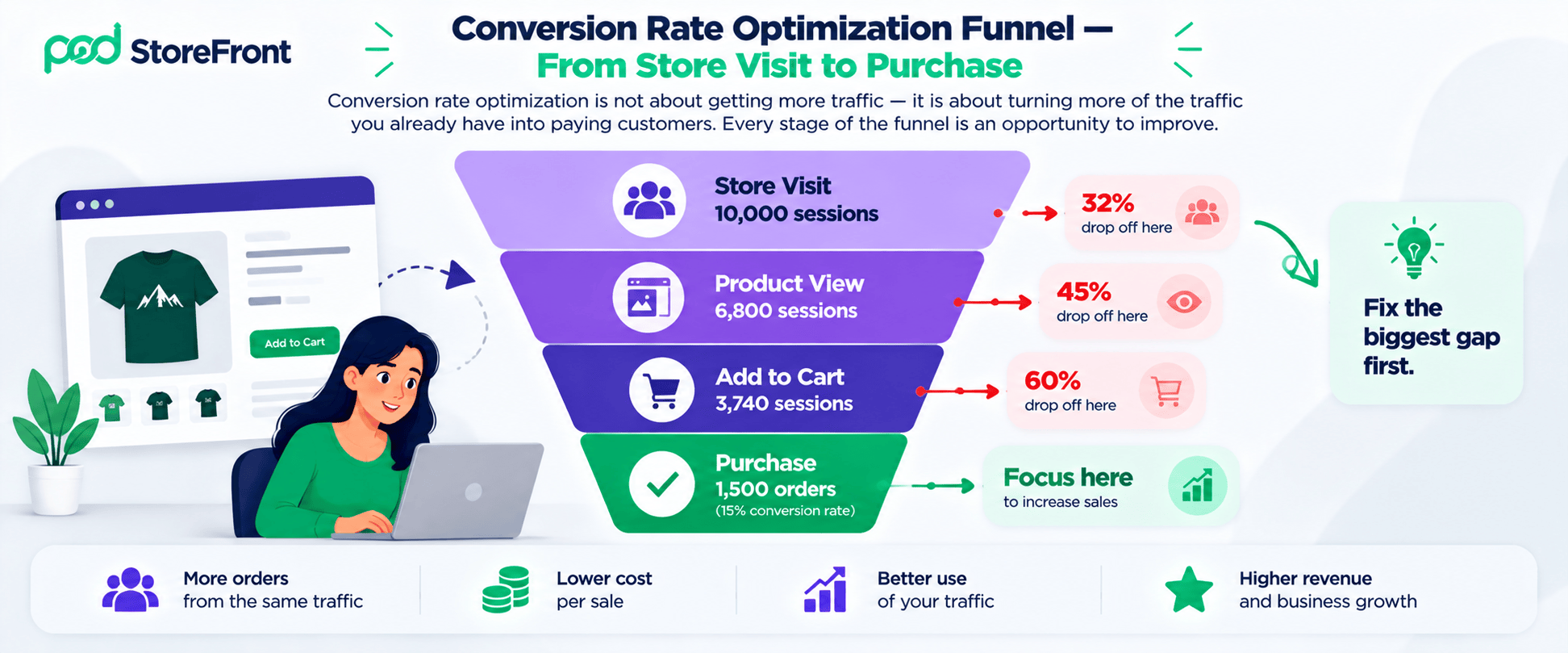
Cart abandonment is the biggest silent revenue leak in ecommerce. Here is exactly how to fix it before and after it happens.
Cart Abandonment: The Problem Nobody Talks About Honestly
Cart abandonment is costing your store more than you realise. Roughly 70% of shoppers who add something to their cart never complete the purchase that is the majority of people who showed enough interest to pick a product, choose a variant, and click “Add to Cart,” walking away before spending a single rupee.
The instinct is to treat cart abandonment as a recovery problem. Send a reminder email. Add a discount. Retarget them on Instagram. Those tactics have their place, but they treat the symptom rather than the cause. The more important question is: why are people leaving in the first place?

Most cart abandonment is not about price. It is not about customers changing their minds. It is about friction — unexpected costs, slow pages, confusing checkouts, a lack of confidence in what they are buying, and checkout flows that feel designed to tire people out rather than help them complete a purchase.
This guide covers both sides: how to stop cart abandonment before it happens, and how to recover it when it does.
According to the Baymard Institute, the average documented online shopping cart abandonment rate is 70.19% — making it one of the most studied problems in ecommerce. Google’s research on checkout friction consistently shows that simplifying the checkout experience directly improves conversion rates across store types and sizes.
Part One: 9 Proven Ways to Stop Cart Abandonment Before It Happens
Fix 1: Show the Full Price Early to Prevent Cart Abandonment
The single biggest driver of cart abandonment, consistently across every study on the topic, is unexpected costs at checkout. A customer sees a product for a certain price, adds it to their cart, reaches the payment screen, and discovers shipping fees, taxes, or handling charges that were never mentioned.
At that point, the mental contract breaks. They feel misled — even if they were not — and they leave.

The fix is straightforward: show the full landed cost as early as possible. Display a shipping estimate on the product page. Show taxes inclusive in your pricing where applicable. Add a shipping calculator to the cart page so customers know exactly what they are committing to before they reach checkout.
Surprises are fine in other parts of life. In ecommerce checkout, they are cart abandonment triggers.
Fix 2: Remove Forced Account Creation
Making customers create an account before they can check out is one of the most well-documented cart abandonment causes in ecommerce. A first-time buyer does not want a relationship with your store yet — they want to complete a transaction. Forcing them to register first adds friction at the exact moment they are ready to pay.
Offer guest checkout as the default option. You can still invite customers to create an account after the purchase is complete, when they are in a positive frame of mind. The conversion rate on post-purchase account creation is significantly higher than pre-checkout forced registration.
Fix 3: Simplify Your Checkout Flow to Reduce Cart Abandonment
Count the steps between “Add to Cart” and “Order Confirmed.” Every additional step is an opportunity for a customer to reconsider, get distracted, or give up. A bloated checkout is one of the most direct cart abandonment drivers you can control.
A well-optimised checkout flow that reduces cart abandonment:
- Fits on as few pages as possible — ideally one or two
- Asks only for information genuinely necessary to fulfil the order
- Shows a clear progress indicator so customers know how close they are to finishing
- Auto-fills address fields using address lookup tools
- Saves payment details securely for returning customers
Every field you remove from your checkout form is a small friction reduction. Small friction reductions compound into meaningful cart abandonment improvements.
Fix 4: Add Trust Signals to Lower Cart Abandonment Rates
Customers abandon carts because they are not confident — in your store, in the security of their payment, or in whether the product will match what was shown. Strategic trust signals directly reduce cart abandonment by addressing purchase anxiety at every touchpoint.
Place the following across your product pages, cart, and checkout:
- Security badges near payment fields — SSL indicators, accepted payment logos
- Customer reviews on product pages, ideally with photos
- Clear return and refund policy linked prominently
- Delivery estimates on the product page, not just at checkout
- Real contact information — a visible email or live chat option
Fix 5: Use Live Product Previews to Eliminate Purchase Uncertainty
This is one of the most powerful and underused tools available for reducing cart abandonment on product stores.
A significant portion of cart abandonment on customisable product stores comes from what could be called the “imagination gap” — the customer cannot fully visualise what they are going to receive. They like the idea of the product, but they are not certain enough about how it will actually look to commit to buying it.
Live 3D product customisers close this gap directly. When a customer can rotate a product, see their personalisation applied in real time, zoom in on the detail, and interact with the final result before purchasing — their confidence increases substantially. They are not imagining what the product might look like. They are looking at it.
PODStoreFront’s built-in real-time product customiser does exactly this — allowing customers to personalise products and preview them live before adding to cart, removing the guesswork that drives cart abandonment on personalised product lines. Stores using live preview tools consistently report lower abandonment rates compared to those using static mockup images.
If your store sells anything involving customisation, personalisation, or variation, a live preview experience is not a nice-to-have feature. It is a proven cart abandonment reduction tool. You can also learn more about how PODStoreFront handles ecommerce store creation and automation to understand how the platform addresses conversion from the ground up.
Fix 6: Optimise Mobile Checkout to Cut Cart Abandonment
More than half of ecommerce traffic comes from mobile devices. Yet mobile cart abandonment rates remain significantly higher than desktop — not because mobile shoppers are less willing to buy, but because most checkout flows were designed for desktop first.
A mobile-optimised checkout that reduces cart abandonment:
- Uses large, easy-to-tap input fields and buttons
- Triggers the correct keyboard for each field type
- Supports Google Pay, Apple Pay, and UPI — eliminating the need to type card details on a small screen
- Loads quickly on mobile networks
- Does not require horizontal scrolling or zooming
Test your checkout end-to-end on a real mobile device. What looks fine on a desktop browser can be genuinely painful on a phone — and painful checkouts produce high cart abandonment rates.
Fix 7: Offer Multiple Payment Options to Prevent Checkout Abandonment
Payment method mismatch is a silent cart abandonment driver that rarely gets discussed. A customer reaches the payment screen and their preferred method — UPI, a specific card network, a buy-now-pay-later option, a digital wallet — is not available. They leave, not because they do not want the product, but because the payment process does not accommodate how they want to pay.
Support a broad range of payment methods from day one. Cover major card networks, UPI for Indian customers, popular digital wallets, and at least one buy-now-pay-later option for higher-ticket purchases.
Fix 8: Make Your Return Policy Visible to Reduce Cart Abandonment
A clear, generous, prominently displayed return policy reduces cart abandonment significantly — particularly for first-time customers. Customers who are uncertain about a purchase use the return policy as a safety net. If they can see clearly that returns are easy, the perceived risk of buying drops and so does cart abandonment.
Display your return policy on product pages and in the cart. Write it in plain language, not legal jargon.
Fix 9: Use Exit-Intent Signals to Recover Abandoning Customers
Exit-intent technology detects when a user is about to leave and triggers a prompt — typically an offer or reminder. Used carefully, it can recapture a percentage of cart abandonment cases before they leave entirely.
For cart abandonment recovery via exit-intent, keep it simple:
- A single clear offer — free shipping, a modest discount
- A reminder of what is in their cart
- A save-for-later option for customers not ready to commit
Avoid aggressive countdown timers or multiple overlapping pop-ups. Customers who feel pressured do not convert — and they do not return.
Part Two: 4 Proven Ways to Recover Cart Abandonment After It Happens
No matter how well your store is optimised, some cart abandonment is inevitable. Recovery tactics exist for exactly this reason.
Fix 10: Send a Timely Cart Abandonment Email Sequence
Abandoned cart emails remain one of the highest-performing cart abandonment recovery tactics available — consistently outperforming almost every other retention channel.
A well-structured cart abandonment email sequence:
Email 1 — Within 1 hour:
A gentle reminder. Show the abandoned items, make it easy to return to the cart with one click. No discount yet. Warm and helpful tone.
Email 2 — 24 hours later:
Address common cart abandonment objections — reiterate your return policy, highlight reviews, remind them of delivery times.
Email 3 — 48 to 72 hours later:
A time-limited incentive — a modest discount or free shipping to complete the purchase. Keep urgency genuine.
The three-email cart abandonment sequence works because different customers abandon for different reasons. Some need a reminder. Some need reassurance. Some need a small nudge.
Fix 11: Set Up Retargeting to Recover Cart Abandonment
Customers who abandoned their cart are among the highest-intent audiences you can retarget. They have already demonstrated clear purchase intent — they just did not complete the transaction.
Cart abandonment retargeting on Meta and Google Display shows these customers the specific products they left behind as they browse other sites. Dynamic product ads showing the exact abandoned item bring a meaningful percentage back to complete the purchase.
Fix 12: Offer a Save-for-Later Option for Undecided Shoppers
Not every cart abandonment represents a lost sale entirely. Some customers are simply not ready to buy right now — they are researching, comparing, or waiting for payday.
A save-for-later feature or wishlist gives these customers a way to bookmark their interest. You can follow up when items in their wishlist go on sale or stock is running low — converting cart abandonment into a deferred purchase rather than a lost one.
Fix 13: Use SMS to Recover High-Intent Cart Abandonment
For customers who reached the checkout stage and provided their phone number before abandoning, SMS is one of the most direct cart abandonment recovery channels available. Open rates on SMS messages are dramatically higher than email.
An effective SMS cart abandonment recovery message:
- Is two to three sentences maximum
- Names the specific product they left behind
- Includes a direct link back to their cart
- Optionally includes a time-sensitive offer
SMS cart abandonment recovery works best for customers who reached the payment page — the highest-intent segment of all abandoners.
Cart Abandonment Metrics Worth Tracking
| Metric | What It Tells You |
|---|---|
| Cart Abandonment Rate | Baseline % of customers who add to cart but do not purchase |
| Checkout Abandonment Rate | Friction specifically inside the checkout flow |
| Cart Recovery Rate | Effectiveness of your email, SMS, and retargeting recovery |
| Recovered Cart AOV | Whether recovered customers spend more or less than completers |
Cart Abandonment Pre-Launch Checklist
- Full price visible on product page including shipping estimate
- Guest checkout available as the default option
- Checkout flow tested end-to-end on mobile
- Trust signals present on product pages, cart, and checkout
- Live product preview enabled for customisable products
- Multiple payment methods configured including UPI and wallets
- Return policy visible and written in plain language
- Cart abandonment email sequence set up and tested
- Retargeting audiences configured in Meta and Google
- Analytics tracking cart and checkout abandonment rates separately
The Bottom Line on Cart Abandonment
Cart abandonment is not a mystery — it is a set of identifiable friction points to be removed, one by one.
The stores that consistently convert at above-average rates are not the ones running the cleverest retargeting ads or sending the most aggressive cart abandonment email sequences. They are the ones that made it easy to trust the store, easy to understand the product, easy to complete the checkout, and easy to pay in the preferred way.
Get the fundamentals right first. Then layer cart abandonment recovery tactics on top. The combination of low abandonment and high recovery is where meaningful ecommerce conversion improvements live.
PODStoreFront’s built-in live 3D product customiser, native checkout integrations, and multi-payment gateway support are designed to address the most common cart abandonment drivers from within the platform so you spend less time patching conversion problems and more time growing your business. See how PODStoreFront reduces cart abandonment through platform design.