DTG vs DTF vs sublimation vs screen printing is the question every custom apparel and print-on-demand seller hits sooner or later. Four methods, four different strengths, and a lot of marketing noise. Pick the wrong one and you end up with cracked prints, a price you can’t sell at or a product that won’t work on the fabric you chose.
This guide compares DTG vs DTF vs sublimation vs screen printing in plain English. You’ll get a quick side-by-side table, a short explanation of each method, 7 easy factors to compare and a simple way to choose.
Table of Contents
- DTG vs DTF vs Sublimation vs Screen Printing at a Glance
- What Is DTG Printing?
- What Is DTF Printing?
- What Is Sublimation Printing?
- What Is Screen Printing?
- 7 Easy Factors to Compare
- Which Method Should You Choose?
- Print on Demand Considerations
- Mistakes to Avoid
- Quick FAQs
DTG vs DTF vs Sublimation vs Screen Printing at a Glance
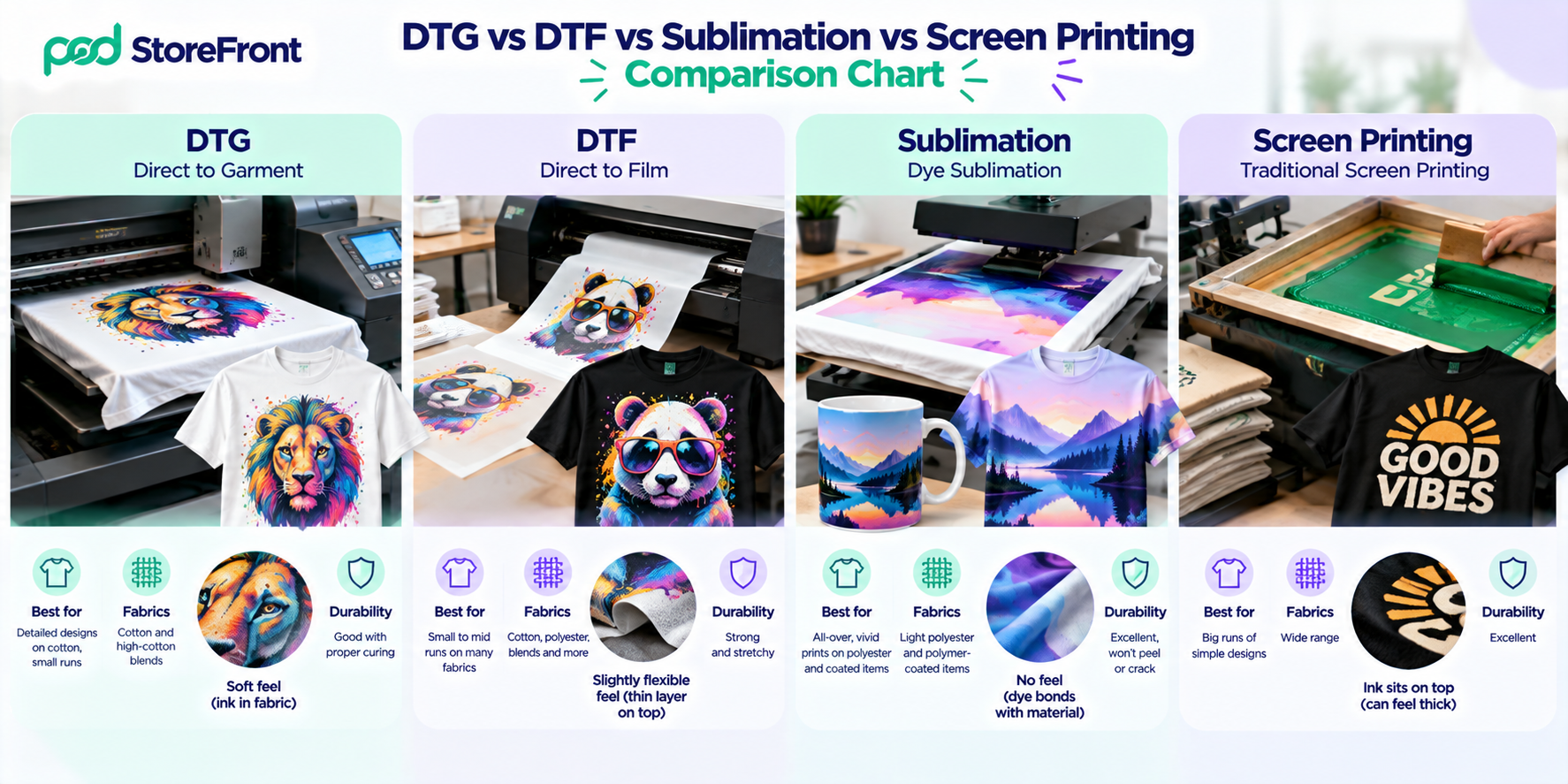
| Properties | DTG | DTF | Sublimation | Screen printing |
|---|---|---|---|---|
| Best for | Detailed designs on cotton, small runs | Small to mid runs on many fabrics | All-over, vivid prints on polyester and coated items | Big runs of simple designs |
| Fabrics | Cotton and high-cotton blends | Cotton, polyester, blends and more | Light polyester and polymer-coated items | Wide range |
| Order size | One-offs to small runs | Small to medium | Small to medium | Medium to large |
| Feel | Soft, ink sits in the fabric | Thin layer on top, slightly flexible | No feel, dye bonds with the material | Ink sits on top, can feel thick |
| Durability | Good with proper curing | Strong and stretchy | Excellent, won’t peel or crack | Excellent |
| Setup | Low, no screens | Low, film and powder | Low | Higher, one screen per color |
| Color and detail | Full color, fine detail | Full color, fine detail | Full color, photo quality | Best with a few solid colors |
What Is DTG Printing?
DTG stands for direct-to-garment. A specialized inkjet printer sprays water-based ink straight onto the fabric, much like a desktop printer prints on paper. Dark garments usually need a pretreatment so the colors stay bright.
It shines on 100% cotton and high-cotton items, where it gives soft, detailed, full-color prints with no screens to set up. That makes it ideal for one-offs and small runs. The trade-off is that it’s slower and costs more per item as volumes grow, and it works less well on polyester.
What Is DTF Printing?
DTF stands for direct-to-film. The design is printed onto a special film, coated with adhesive powder, cured, then pressed onto the garment with heat. Think of it as a high-quality transfer.
The big advantage is flexibility. DTF works on cotton, polyester, blends and many other materials, usually without pretreatment, and the prints are vivid and stretchy. The film transfers can even be printed in advance and stored. The trade-off is a slightly different feel, since the design sits on top of the fabric as a thin layer instead of soaking into it.
What Is Sublimation Printing?
Sublimation uses special dye inks printed onto transfer paper. Heat and pressure turn the dye into a gas that bonds with the material, so the color becomes part of the product instead of sitting on top.
It gives bright, photo-quality, permanent prints with no feel at all, and it can cover a whole garment edge to edge. But it needs polyester or a polymer coating, so it’s perfect for sportswear, mugs, phone cases and mousepads, and it won’t work on cotton or dark fabrics.
What Is Screen Printing?
Screen printing pushes ink through a mesh stencil, called a screen, onto the item. You need one screen for each color, and the screens have to be made before printing starts.
That setup cost is the catch, but once the screens are ready, large runs are fast and the cost per item drops sharply. Prints are bold, vibrant and very durable, and the method works on many materials. It’s best for simple designs with a few solid colors, and it’s less suited to photos or tiny runs.
DTG vs DTF vs Sublimation vs Screen Printing: 7 Easy Factors to Compare
1. Setup and upfront cost
DTG, DTF and sublimation need no screens, so you can start with one design. Screen printing needs a screen for every color, which adds setup cost.
2. Cost per item and order size
For one-offs and small runs, DTG, DTF and sublimation make the most sense. For big runs of the same design, screen printing usually wins, because the setup cost spreads across more items.
3. Color and detail
DTG, DTF and sublimation handle full-color artwork and photos. Screen printing is at its best with a few solid colors and can struggle with gradients.
4. Feel on the garment
DTG feels softest because the ink sits in the fabric. Sublimation has no feel at all. DTF and screen printing leave a layer on top, which some customers like and others don’t.
5. Durability
Screen printing and sublimation are known for lasting a long time. DTF is strong and stretchy. DTG lasts well when it’s cured properly, but it can fade sooner than the others after many washes.
6. Fabrics and products
DTG likes cotton. Sublimation needs polyester or coated surfaces. DTF and screen printing work across the widest range of materials.
7. Speed and turnaround
DTG and DTF are quick to start, with no screens to prepare. Sublimation is also fast. Screen printing is quick once set up but slower to get going.
Which Method Should You Choose?
Use these quick guides:
- Choose DTG for detailed, full-color designs on cotton tees and hoodies, in small runs.
- Choose DTF when you want one method that works on many fabrics, or you print on cotton and polyester blends.
- Choose sublimation for all-over prints on polyester, sportswear, mugs, phone cases and other coated items.
- Choose screen printing for large runs of simple, few-color designs where cost per item matters most.
Still unsure? Match the method to your product first, then your order size, then your design.
DTG vs DTF vs Sublimation vs Screen Printing for Print on Demand
In print on demand, you usually don’t pick the printing machine, your fulfillment partner does. Most partners focus on one or two methods, such as DTG for cotton apparel and sublimation for mugs and all-over products. That means the method you get depends on the product and the partner you choose.
Before you pick a partner, ask which method they use for each product, request samples and wash-test them. The method affects your product range, feel, durability and price, so it matters for your brand.
A print-on-demand website builder like PODStoreFront helps here, because it lets shoppers preview and personalize products with a product customizer and generates print-ready files automatically, so designs reach production in the right format.
Mistakes to Avoid When Comparing DTG vs DTF vs Sublimation
- Choosing on price alone. The cheapest method for 10 items is rarely the cheapest for 1,000.
- Using sublimation on cotton. It needs polyester or coated surfaces to work.
- Ignoring order size. Screen printing setup costs make small runs expensive.
- Skipping samples. Always check feel, color and durability on a real product.
- Skipping wash tests. A print that looks great new can fade or crack after a few washes.
- Mismatching design and method. Photos suit DTG, DTF and sublimation. Simple logos suit screen printing.
DTG vs DTF vs Sublimation vs Screen Printing: Frequently Asked Questions
Q. What is the difference between DTG vs DTF vs sublimation?
Ans. DTG prints ink directly onto fabric, DTF prints onto a film that’s heat-pressed on, and sublimation bonds dye into polyester or coated surfaces. Screen printing pushes ink through screens, one per color.
Q. Which method is cheapest?
Ans. It depends on order size. For small runs, DTG, DTF and sublimation are usually cheaper. For large runs, screen printing often wins.
Q. Which lasts the longest?
Ans. Screen printing and sublimation are known for durability. Good DTF is strong too, and DTG lasts well when properly cured.
Q. Can sublimation print on cotton?
Ans. Not well. It’s designed for polyester and polymer-coated items, so cotton and dark fabrics aren’t a good fit.
Q. Which is best for beginners in print on demand?
Ans. DTG and DTF are the easiest starting points, because they work well for small runs with no setup. Your fulfillment partner’s methods will shape the final choice.
Ready to Launch Your Custom Print Store?
Whatever method you choose, you need a store that sells it well. With PODStoreFront, you can launch a branded online store with a no-code builder, let shoppers personalize products before they buy and send orders to your print partners automatically. Most stores go live in 48 hours, with no developer needed.
Book a demo with PODStoreFront and see how fast you can go from idea to first order.